You applied for a personal loan on Monday. By Wednesday, ₹3 lakh was sitting in your account. And by Thursday, you realised you either did not need it, found a cheaper option, or simply changed your mind.
Can you undo it?
Taking a personal loan has become extremely simple in today's digital age - with just a few clicks on banking apps or lending platforms, money gets credited to your account within minutes.
However, many borrowers later realise that the loan may not have been the right decision. If you have found yourself in such a situation, there is good news.
The Reserve Bank of India provides a safety feature called the "cooling-off period", which allows you to cancel your personal loan without major penalties.
This guide covers exactly what to do - step by step, bank by bank - and what happens if you miss the window. Before we begin, let us see what are the major highlights related to loan cancellation rules in 2026.
Latest Highlights: Loan Cancellation Rules in 2026
The following are the major highlights:
As per updated RBI guidelines, lenders must provide a Key Facts Statement (KFS) before you finalise a loan - this document clearly outlines the cooling-off period, all fees, and cancellation conditions. Reading the KFS carefully can help you avoid falling into a debt trap in the first place.
From January 2026, a zero prepayment penalty applies on floating rate personal loans - making full foreclosure (after the cooling-off period) significantly cheaper than before.
RBI's Digital Lending Directions 2025 mandate that all regulated lending apps must clearly state the cooling-off period in the loan agreement - non-disclosure is a consumer protection violation.
Bajaj Finance now accepts online loan cancellation requests through its Experia Customer Portal, Bajaj Finserv App, IVR at 8698010101, or branch visit - no physical documentation required for amounts under ₹5 lakh.
The Most Important Thing to Know: The Cooling-Off Period
Now, let us first understand what a cooling period is in some detail.
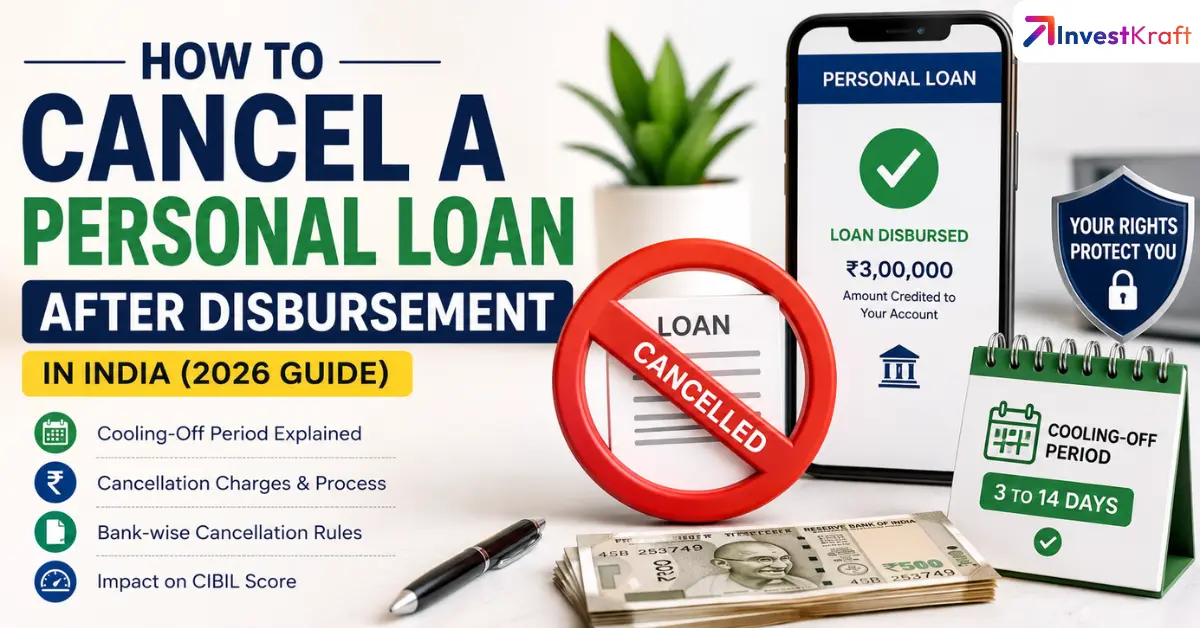
Some lenders offer a short cooling-off period, usually 3 to 7 days after disbursement, during which you can cancel a loan application without incurring penalties. This window allows borrowers to change their minds if they realise the loan terms are not suitable for them.
In India, you can cancel a personal loan even after disbursement, but only within the specific cooling-off or look-back period defined by the lender's terms.
Once this window closes, cancellation is typically not allowed.
Cooling-off periods across major lenders
Lender
Cooling-Off Period
Cancellation Channel
Bajaj Finance
As per the loan agreement (typically 3 to 14 days)
App, IVR 8698010101, branch, Experia portal
HDFC Bank
Check loan agreement - premature closure allowed after first EMI
Online service request portal
ICICI Bank
As per the loan terms
iMobile, customer care 1860 120 7777
Axis Bank
As per the sanction letter
Net banking, branch, customer care
Tata Capital
Typically 7 to 14 days
Customer portal or branch
SBI
As per the loan agreement
Branch or YONO app
Fintech/NBFC Apps
1 to 7 days typically
In-app request
What to do first: Open your loan agreement or sanction letter and find the section titled "Cancellation Policy," "Cooling-Off Period," or "Look-Back Period." The exact number of days and the fees are stated there. Do this before making any calls.
Can You Cancel Before Disbursement?
Yes, easily.
If you cancel the loan before disbursement, there typically will not be any impact on your credit score or significant fees.
If you have received a sanction letter but funds have not yet hit your bank account:
The processing fee may or may not be refundable - check your sanction letter
No interest is payable since no funds were disbursed
CIBIL impact is minimal - the hard enquiry stays, but no loan account is created
This is the easiest and cheapest point to stop. If you change your mind at the approval stage, act before disbursement happens.
Step-by-Step: How to Cancel a Personal Loan After Disbursement
Now, let us look at the 5 most important steps through which you can cancel your personal loan disbursement:
Step 1: Read Your Loan Agreement - Today
The correct approach starts with thoroughly reviewing your loan agreement to understand the permitted cancellation period, applicable charges, and procedural requirements.
Look specifically for:
The number of days in the cooling-off window
Whether the processing fee is refundable or not
Any cancellation or documentation charge.
How to calculate accrued interest (usually daily rate × number of days disbursed)
Step 2: Contact Your Lender Immediately
Contact your lender's customer service team or visit their nearest branch to notify them about your intent to cancel the loan. Be prepared to explain your reason for cancellation clearly - whether due to a change in financial circumstances, availability of alternative funds, or other personal reasons.
Do two things simultaneously: call customer care AND send a written email. The clock is ticking on your cooling-off window.
Step 3: Submit a Formal Written Request
Send an email or submit a request through the lender's app or portal with the following:
Your full name and registered mobile number
Loan account number
Disbursed amount
Reason for cancellation (brief and factual)
Date of disbursement
Request for confirmation of cancellation charges
Bajaj Finance requires full name, loan account number, reason(s) for cancellation, and return of the disbursal amount through cheque/DD (favouring Bajaj Finance Ltd) or cash at the branch or online payment.
Step 4: Repay the Full Principal Plus Accrued Interest
In cases where a portion or all of the loan has been disbursed before cancellation, lenders charge interest for the period during which the funds were available - calculated from the date of disbursement until the date the cancellation is processed.
What you will typically pay to cancel:
Charge
Typical Amount
Refundable?
Principal (full disbursed amount)
100% of loan amount
Returned - you are repaying the loan
Accrued interest
Daily rate × days held
Not returned - interest for days held
Processing fee
Already deducted at disbursement
Usually non-refundable
Cancellation/documentation fee
₹500 to ₹2,000 (lender-specific)
No
GST on fees
18% on applicable charges
No
Example:
₹3 lakh personal loan disbursed on May 1 at 15% p.a.
You cancel on May 5 (4 days later)
Daily interest rate = 15% ÷ 365 = 0.041% per day Interest for 4 days = ₹3,00,000 × 0.041% × 4 = ₹493 Total to repay = ₹3,00,000 + ₹493 + any documentation fee
The faster you act, the lower the interest amount owed.
Step 5: Obtain Written Confirmation and NOC
Once repayment is made, get written confirmation from the lender. It will indicate that the loan has been formally cancelled. This documentation protects you from future liability.
Request specifically:
Written cancellation confirmation (email or letter)
Confirmation that the loan account will be closed and updated with credit bureaus
Keep this document permanently. It protects you if the lender's system incorrectly shows an outstanding balance or if the account is not updated on your CIBIL report.
How Loan Cancellation Affects Your CIBIL Score
Let us find out if your CIBIL score gets affected by loan cancellation or not:
If you cancel the loan within the cooling-off period and return the full amount, the impact on your credit score may be minimal. The loan might not even appear on your credit report. If the loan amount has been used and repayment occurs after a delay, it could be reported to credit bureaus. Any missed payments during this period might negatively affect your credit score.
Cancelling a personal loan after disbursement may temporarily impact your credit score due to changes in your credit utilisation and repayment history.
In practice:
Cancel within the cooling-off period with repayment immediately means minimal to zero lasting CIBIL impact
Hard enquiry from the original application stays for 24 months, but reduces in weight after 6 months
Loan shown as "Closed" shortly after repayment is actually positive long-term (shows you managed and closed a credit account)
What If the Cooling-Off Period Has Expired?
If the disbursement has already been used or the cooling-off period has lapsed, cancellation is not feasible. In such cases, your alternatives include early foreclosure, prepayment, or loan restructuring.
Option 1 - Full Foreclosure: Repay the entire outstanding principal in one go. From January 2026, the RBI mandates zero prepayment penalty on floating rate personal loans for individual borrowers. For fixed-rate loans, check your agreement - charges of 2% to 5% may apply.
Option 2 - Partial Prepayment: Make a partial prepayment to reduce the outstanding principal and lower your future EMIs, instead of cancelling the entire loan. Check for any applicable pre-closing charges before proceeding.
Option 3 - Debt Consolidation: Consider consolidating your existing loan with another loan that offers better terms, which could reduce your overall repayment burden.
Option 4 - Balance Transfer: If you found a cheaper loan elsewhere, a balance transfer to a new lender at a lower rate is often more practical than paying foreclosure charges.
Option 5 - Negotiate EMI Restructuring: If you have faced challenges, discuss potential solutions with your lender to avoid cancellation. Most lenders have internal restructuring options - stepped EMIs, extended tenure, or a temporary moratorium - that can ease repayment without the full cost of foreclosure.
Bank-Specific Cancellations
The following can be used as a quick reference guide for bank-specific cancellations:
Bajaj Finance: Request via IVR (8698010101), Experia Customer Portal, Bajaj Finserv App, or branch. Return disbursal amount via cheque/DD, favouring "Bajaj Finance Ltd" or online payment. Charges apply as per the loan agreement.
HDFC Bank: Raise an online service request for premature closure via HDFC's portal. Partial prepayment allowed post-first EMI payment.
ICICI Bank: Contact customer care at 1860 120 7777 or use iMobile Pay app → Loans → Service Request → Pre-closure.
Axis Bank: Submit a written request via the net banking service section or visit a branch. Confirm the cooling-off period from your sanction letter first.
SBI: Visit your home branch with your loan account number and a written cancellation request. The YONO app service request is also available.
Common Mistakes to Avoid
The following are the common mistakes you must avoid under all circumstances:
Waiting too long after disbursement: every day adds accrued interest to your repayment amount.
Not getting written confirmation: verbal confirmation from a call centre agent is not sufficient. Always get it in writing.
Assuming the processing fee will be refunded: it almost never is. Factor this in when deciding whether to cancel.
Not checking CIBIL after 30 to 60 days: verify that the lender has updated your credit bureau record to show the account as closed. Raise a dispute via cibil.com if the account still shows as active.
Confusing cancellation with the first EMI: paying your first EMI does not mean you have cancelled the loan. Cancellation is a separate formal process.
Summary
Cancelling a personal loan after disbursement in India in 2026 is possible - but only within the cooling-off window and at a cost. Here is the complete recap:
Before disbursement: Cancel anytime - minimal fees, no interest, no CIBIL impact.
Within the cooling-off period (typically 3 to 14 days): Return full principal + accrued daily interest + any documentation fee. The processing fee is usually not refunded. CIBIL impact is minimal.
After the cooling-off period expires, cancellation is not available. Options are full foreclosure (zero penalty on floating rate per RBI 2026 rules), partial prepayment, balance transfer, or EMI restructuring.
Key action checklist:
Read your KFS and loan agreement immediately to find the cooling-off window
Contact the lender via call AND email simultaneously
Submit a formal written request with the loan account number and reason.
Repay principal & accrued interest within the window
Collect the written NOC and verify the CIBIL update after 30 to 60 days
The faster you act, the lower your cost. Every day you wait after the disbursement adds interest to the cancellation bill.
Frequently Asked Questions
Can I cancel a personal loan after disbursement?
Yes - but only within the specific cooling-off or look-back period defined by your lender's terms; once this window closes, cancellation is typically not allowed, and foreclosure becomes the only option.
How do I cancel an HDFC personal loan after disbursement?
Raise an online service request for premature closure through HDFC's personal loan service portal; partial prepayment is also allowed after payment of the first EMI.
What charges do I need to pay to cancel a personal loan after disbursement?
Charges include accrued interest for the period funds were held, any cancellation or documentation fee, and GST on applicable charges; the processing fee deducted at disbursement is typically non-refundable.
Does cancelling a personal loan affect my CIBIL score?
If cancelled within the cooling-off period with full repayment, the impact may be minimal and the loan might not even appear on your credit report; delays or missed payments during the process can negatively affect your score.
Can a bank cancel my loan after disbursement?
Yes - banks can recall a loan post-disbursement if they discover fraud, misrepresentation in application documents, or a breach of the loan agreement terms; this is rare for salaried borrowers with clean documentation.
What is the Bajaj Finance loan cancellation process?
Contact Bajaj Finance via IVR at 8698010101, the Experia Customer Portal, the Bajaj Finserv App, or a branch visit; provide your full name, loan account number, reason for cancellation, and return the disbursal amount via cheque, DD, or online payment.
What if I have already spent the loan amount and cannot repay it?
If the money is spent and the cooling-off period has passed, cancellation is not feasible - your options are full foreclosure (zero penalty on floating rate loans per RBI 2026 mandate), partial prepayment to reduce outstanding, or contacting your lender to negotiate EMI restructuring.
Sources
RBI - Cooling-Off Period and KFS Requirements under Digital Lending Directions 2025: rbi.org.in
Bajaj Finance - Cooling-Off/Look-Back Period Loan Cancellation Customer Information Note: bajajfinserv.in/cancel-personal-loan-disbursement
Bajaj Finserv - Cancel Loan After Approval: bajajfinserv.in/cancel-loan-after-approval
Aditya Birla Capital - Cancel Personal Loan Disbursement Step-by-Step: adityabirlacapital.com/loans/blogs/personal-finance/cancel-personal-loan-disbursement
HDFC Bank - How to Close a Personal Loan: hdfc.bank.in/blogs/personal-loan/how-to-close-a-personal-loan
Airtel Finance - Cancelling a Personal Loan: What You Need to Know (May 2025): airtel.in/blog/personal-loan/cancelling-a-personal-loan-what-you-need-to-know
HeroFinCorp - How to Cancel a Personal Loan After Deal Confirmation: herofincorp.com/blog/how-do-i-cancel-a-personal-loan-after-deal-confirmation
Tata Capital - Cooling-Off Period Guide: tatacapital.com/blog/personal-use-loan/cooling-off-period
Disclaimer: Cooling-off periods, cancellation charges, and foreclosure penalties vary by lender and are subject to change. RBI prepayment penalty waiver applies to floating rate personal loans sanctioned or renewed on or after January 1, 2026. Always verify current terms in your loan agreement or with your lender's customer care. This article is for informational purposes only.
Author: Diwakar Kumar Singh
Diwakar Kumar Singh is a BFSI specialist and finance writer with over 7 years of hands-on experience in financial research, content creation, and analysis.
A Gold Medalist in MBA (Marketing) from IMT, he combines deep analytical skills with practical insights gained from evaluating companies, IPOs, unlisted shares, financial ratios, and investment opportunities. Diwakar has personally analysed hundreds of financial instruments and market scenarios, which he uses to break down complex topics into clear, actionable advice.
He has authored numerous in-depth finance articles, published multiple books internationally, and contributed to research publications. His work focuses on helping everyday investors and readers make better-informed financial decisions through well-researched, evidence-based explanations that are always grounded in real-world application rather than theory alone.


 care@investkraft.com
 +91-9599071040
 +91-9797971876